
Soviet War Songs I: The Great Patriotic War
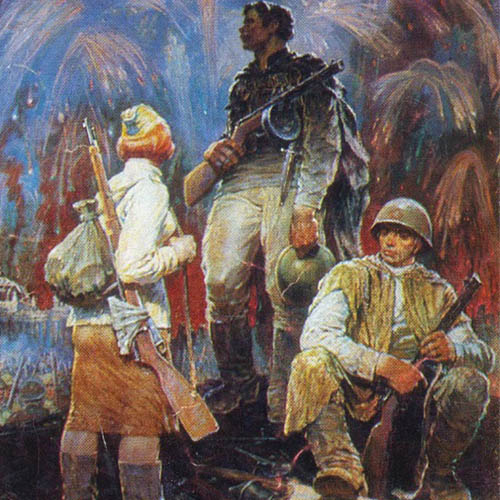
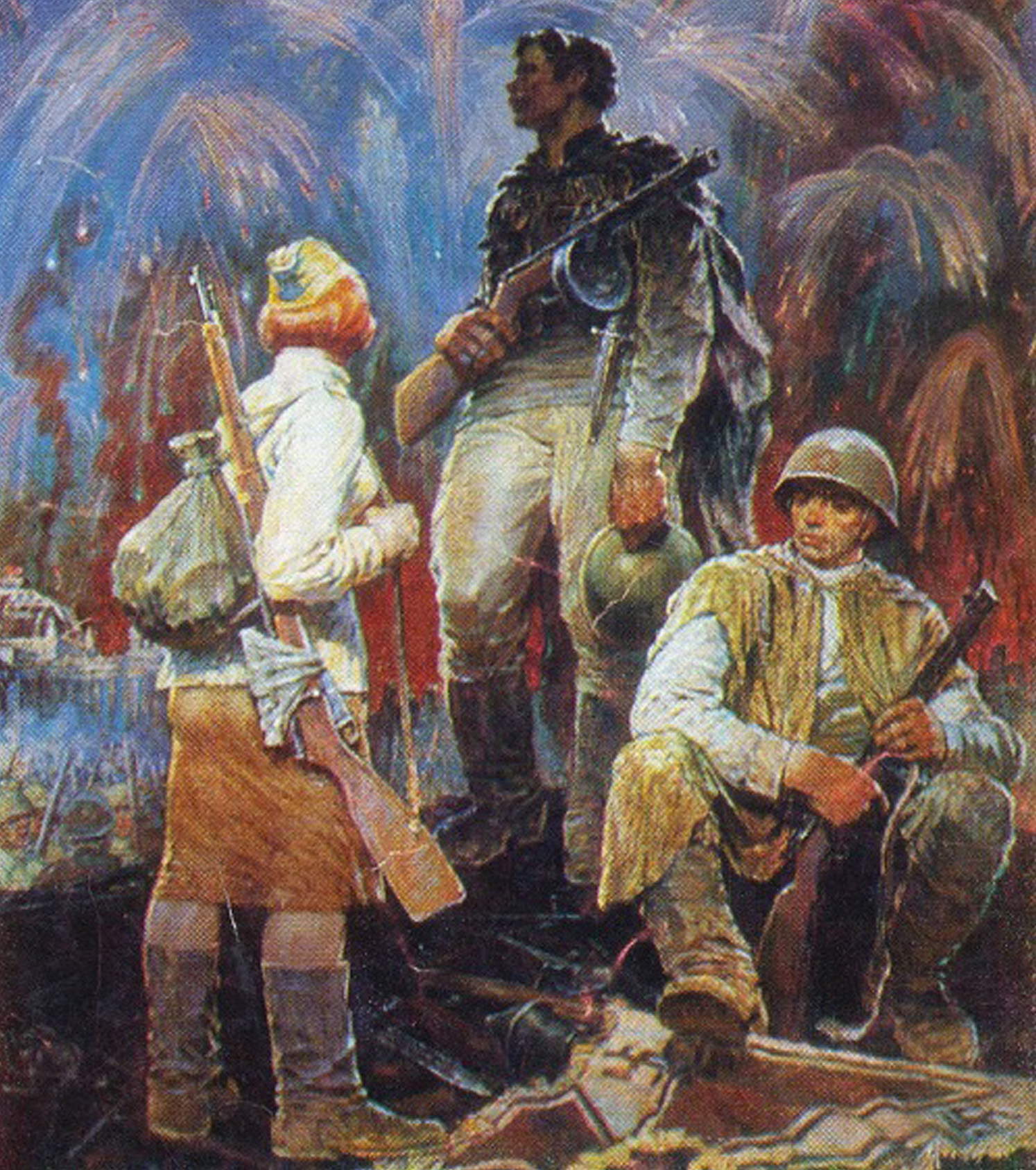
Victory by Mikhail Kornetsky. Credits: soviet-art.ru
In recent years, the term “the mysterious russian soul” has become a crutch for lazy propagandists and pseudo-sociologists. There is a notion among many that Russians are different categorically from those of Western Europe, some unbridgable gap. But they are, as much as the actions and beliefs of many Russians would seem to suggest the opposite, people. They produce art, culture, and music, and they have stories and perspectives that are told through these works. These narratives should be understood, even if they shouldn’t be sympathized with.
The Second World War was an apocalyptic event in Eastern Europe, and the scars of it have inspired art of all kinds, from literature to film, and of course music. Though the war was hard on all of the occupied peoples, the occupation of the West and East can hardly be compared. In the east, the “Holocaust by Bullets” had been ongoing since the very start of Operation Barbarossa, and even as the Nazis would begin systematically exterminating the Jewish population in 1942, all extermination camps were set up in Poland. This, as well as the Nazis’ ideological hatred of Slavs, made the war in the east a far more brutal and bloody one.
It should not be surprising then that the Red Army viewed themselves as fighting a war to defend humanity, they were. This, of course, should not be used to forgive the horrific atrocities that the Soviets would perpetrate against their own minority populations throughout the course of this war, nor excuse their own allyship with the Nazis. However, this is how the Red Army saw itself, and thus influenced the music that was made for the troops.
Something to note is that in the Second World War, the songs were written not by soldiers, but rather by those who were musicians by trade, and were then disseminated by the Red Army as an organization. This had to do with the style of music that was being made; many were orchestral with many instruments or sometimes entire choirs being used for one piece. One interesting feature that this left on the songs from this era is that many would have their lyrics changed to align with the political goals of the Soviet Union after the conclusion of the Second World War.
Religious defence of an atheist state
The Sacred War (1941), or sometimes known as Arise, Great Country! is a piece made at the very start of the war. It was composed by Alexander Alexandrov, with the lyrics written by Vasily Lebedev-Kumach.
The song invokes religious themes throughout, ironic given that the Soviet Union had spent much of the previous decades trying to stamp out the Orthodox faith, but perhaps understandable given the scale and terror of the threat that the country was facing.
The lyrics are meant to drive the listener to their patriotic duty to defend the motherland, with lyrics like “This is the people’s war, A sacred war” underlining the collective nature of the struggle. The song also mentions atrocities committed by the Nazis, calling them “The rapists and the plunderers, The torturers of people!”.
This line, however, was not based on any specific event. With the piece being created less than 2 days after the start of Operation Barbarossa and the collapse of the soviet front, no reliable information existed for them to base their song on. They would, unfortunately, be vindicated. When the Red Army was able to reorganize, the stories of the horrors committed by the nazis would confirm what Lebedev-Kumach had written.
Post-war censorship
March of the Artillerymen (1943), written by Viktor Gusev and composed by Tekhin Khennikov, is a marching song for Artillerymen.
The piece on its own is nothing so remarkable lyrically or compositionally. That isn’t said as a disparagement; it is competently written and composed, it just isn’t unique. What’s unique about the piece is its history after the war. This song would be changed to reflect the new politics of the times twice.
The first time was during the Destalinization, wherein mentions of Stalin were scrubbed from the song. The second round of edits happened during the Brezhnev premiership, 20 years after the end of the Second World War. These reforms focused on the party as a part of the soviet citizens’ life, prompting a change of lyrics in this 20-year-old marching song. The lyric “In honor of army, in honor of the people” was changed to “In honor of party, in honor of the people”.
One song with surprisingly recent history is Dark Is the Night, which saw a recent resurgence in popularity on TikTok and other platforms. “Dark Is the Night”, as is the case with all of the songs in this article, is not a song written by soldiers. It was written by Nikita Bogoslovsky and Vladimir Agatov, first being performed in 1943 by Mark Bernes for the film Two Soldiers.
It is notably different from the other songs in this article as it is not an orchestral piece, not loud and bombastic, but somber and slow. The piece is lyrically focused, with the piano and violin serving only to complement the emotion in the singer’s voice. Bogoslovsky was politically ostracized for writing the piece as Soviet officials accused him of writing “Philistine sentimental tunes”.
Another reason could be that his ostracization had to do with the fact that this type of music could be produced by soldiers at the front, allowing for their perspectives of the war to be carried into cultural memory, threatening the narrative control of the government. Given the many mistakes of the Stavka and Stalin specifically, and with the new, vastly expanded borders of the Soviet Union over nations that had at best mixed feelings towards the government in Moscow, it was politically pertinent to stop the spread of such songs.
Narratives in the verse
The meaning of this art is clear. It is explicitly stated in The Sacred War, the story it tells is of a noble defense against Fascism and for humanity. But it is also important to remember what this art doesn’t say, the stories it doesn’t tell. It does not tell of the Soviet Union’s own collaboration with the Nazis, nor of their genocides against various ethnic minorities within the Soviet Union.
The songs of the Second World War are in many ways unique in the context of Russian war songs. Though they may follow individuals, they all relate in some way to the narrative of the noble heroic defence of the homeland and of humanity. Of course, some of this is because the style of music that was in fashion was orchestral pieces; therefore, the songs of this type had to come from a centralized place behind the line.
However, not all of this perspective is because the government had strong editorial control of such songs; even the somber songs are not so because of a lack of belief in the cause they are fighting for. Rather, the tone came from the realities of fighting a war. These ideas would be replaced in later wars, when Soviet troops fought in Afghanistan, the sentiment was not that this was a war that was worth fighting despite the cost, and it is shown in how the soldiers would write about it.


